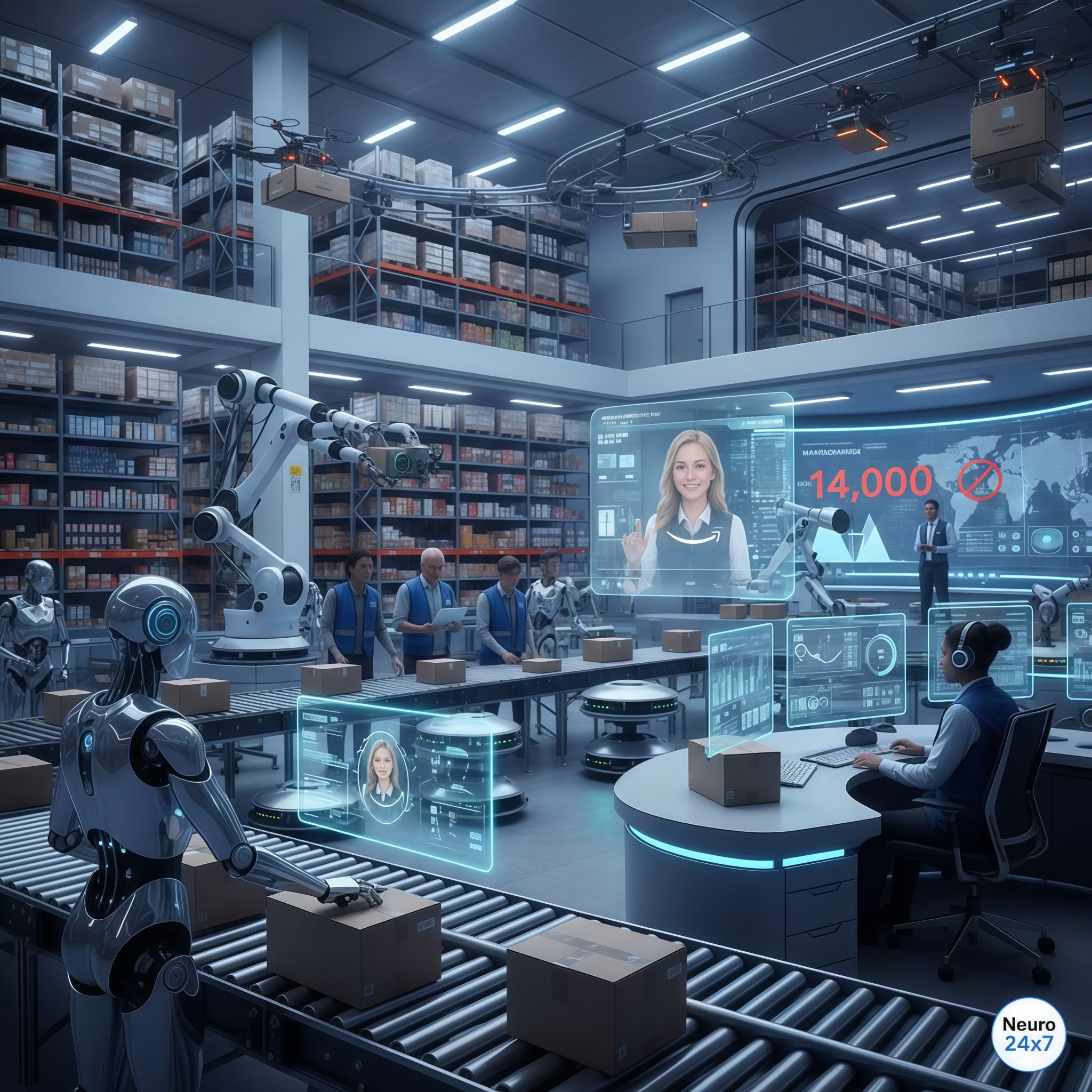
Amazon Announces Large-Scale Layoffs and Implementation of Artificial Intelligence
The era of digital transformation in which we live continues to exert a profound influence on the global labour market. The latest news from the tech world cannot leave one indifferent: Amazon, one of the largest players in e-commerce and the technology sector, has announced plans to lay off 14 000 employees and replace them with artificial intelligence (AI) systems. This news swiftly made headlines and sparked considerable discussion about the future of work, automation and the economic impact of AI.
Based on data from research reports by the largest analytics and business-research centres, one can confidently say that this Amazon initiative represents not just a workforce reduction, but a strategic move in developing and optimizing business processes using AI technologies. Below we discuss how this will affect the labour market, what AI technologies will be used, and how these changes could reshape the business landscape.
Why has Amazon decided to cut 14,000 employees right now?
In recent years Amazon demonstrated rapid growth and active expansion, including by increasing its headcount. However, in the spring of 2024 the company announced plans to reduce its staff by 14 000 people. According to Amazon representatives, this decision is connected with the necessity to increase operational efficiency and to use advanced technologies that can automate many tasks previously performed by humans. Research agencies such as McKinsey & Company and Deloitte indicate that in conditions of market instability and global economic changes, large corporations are forced to seek new ways to reduce costs. Investments in AI typically result in long-term savings and increased productivity. Amazon, as a tech company, strives to remain a leader in its industry and to adapt to market changes.
Moreover, in recent years Amazon has recorded signs of increased automation in its warehousing, delivery and customer-support processes. Management notes that AI and robotics allow faster order processing, fewer errors and 24/7 operation without breaks. Replacing part of the workforce with AI is a logical step for a company striving toward optimization.
What AI technologies will be used?
The application of AI at Amazon spans several key areas.
First, logistics and warehousing automation via intelligent robots. Amazon already actively uses robots capable of sorting, moving and packing goods in its distribution centres. New robotic solutions will be accompanied by machine-learning systems that optimise routes and order volumes, thereby reducing delivery time.
Second, the use of AI in customer support is entering a new level. Chatbots and voice assistants are increasingly advanced, capable of recognising and anticipating buyer queries and helping them resolve issues without human involvement. In the near future, typical questions and claims might be processed almost entirely by software.
Third, AI will be implemented in inventory management and demand-forecasting processes. Big-data analysis systems will be able to predict market changes and quickly adapt product offerings. Such accuracy helps optimise procurement and prevents shortages or surpluses. According to an analytical review by Gartner, these technologies are part of a broader trend of large enterprises shifting toward so-called “smart business”, where AI and automation become key drivers of efficiency.
Impact on Employees and the Labour Market
The announced layoffs and AI deployment will inevitably cause changes in employment structures at Amazon and in adjacent sectors. The loss of 14 000 jobs is a serious challenge, considering that Amazon has been one of the largest employers in the U.S., providing thousands of jobs in recent years. According to a study by the Brookings Institution, the shift toward automation causes both reduction of traditional jobs and the creation of new professions related to technology development and servicing. However, in the short term, workers face the need for retraining and adaptation to new market requirements. Particularly vulnerable are warehouse assistants, couriers and call-centre operators. For many of them, replacement by AI may mean job loss. At the same time, specialists in AI development, data analytics and digital-transformation management will be in much higher demand. Amazon has announced support programmes for employees affected by the layoffs, including help with retraining and finding new jobs. This reflects a new business reality where companies bear social responsibility for their workforce policy in the AI era.
How does this relate to global trends in AI and automation?
Amazon’s initiative is part of a broader global trend. Today AI is integrating into all spheres of the economy: from manufacturing and transportation to finance and healthcare. Automation enables companies to improve productivity and cut costs, but simultaneously triggers debates about ethics, worker protection and labour-market regulation. Experts from the World Economic Forum note that automation is rapidly transforming professions and raising skill-requirements. According to forecasts, by 2030 about 30-40% of work processes across various industries may be automated using AI and robotics. Amazon is among the first companies implementing such changes at scale, and its example will be closely studied by both business communities and regulators. How reactions to the layoffs and their social consequences are handled will influence future legislation and policy in the area.
Future of Amazon After AI Implementation
The deployment of AI and the replacement of employees is not just about numbers and processes, but about a new strategic milestone for Amazon. The layoffs are viewed not as business stagnation, but as renewal and preparation for new challenges. AI use will allow Amazon to process orders faster, expand its customer base and improve service quality. The potential of the technology in data analysis and service personalisation opens new horizons for growth. For example, the machine-learning models being deployed will predict customer preferences and recommend products with unprecedented accuracy. From an investor’s perspective, such steps strengthen confidence in Amazon’s technological leadership and its ability to adapt to rapidly changing market conditions. Moreover, digitisation and automation create new business models previously unavailable.
Challenges and Opportunities Accompanying this Transformation
It should be noted that large-scale automation and workforce reduction are not just technical processes, but complex challenges for business, society and the state. Key issues include the adaptation of workers to new professions, ensuring social stability and developing education in line with new requirements. At the same time, AI creates many new opportunities. It enables not only efficiency improvements but also the development of innovative products and services. New professions emerge in AI development, big-data analytics, cyber-security and digital marketing. Beyond labour-market effects, AI offers prospects for sustainable development. Optimising logistics and reducing costs lowers carbon footprints and increases corporate economic resilience. In this sense, Amazon is one of the pioneers able to influence global trends.
What to Expect from the Human-AI Interaction in Business?
Amazon’s shift to AI demonstrates that in the future the relationship between humans and technology will become more integrated. In some cases AI will replace routine tasks, freeing people for creative and strategic work. In others, people will manage and oversee algorithms, ensuring their ethicality and effectiveness. AI-development experts emphasise the importance of balancing automation with the human factor. Success of digital transformation depends directly on companies’ ability to invest in staff training and create conditions for fruitful human-machine collaboration. For Amazon this process will be a major test, showing how a large corporation can harmoniously integrate AI while maintaining leadership and social responsibility.
Global Market Attention and Social Response
The news of Amazon cutting 14 000 employees caused broad resonance in the media and on social networks. Trade unions and activists expressed concern and called on the company to reconsider the scale of automation, emphasising social responsibility. At the same time analysts point out that rejecting technology adoption might threaten competitiveness — thus the task for business and government is to create conditions for a safe and fair transition to the digital economy. Some countries are already developing support programmes for workers impacted by automation. Amazon, as a global-scale company, is already engaging in dialogue with the public and regulators, reflecting a mature approach to transformation and the desire to account for the demands of various stakeholders.
Promising Directions for AI in Retail
Behind Amazon’s changes stand key AI-development directions that are already transforming retail worldwide. Among such trends are smart warehouse systems, predictive analytics, personalised customer experience and voice-controlled ordering. Development of new machine-learning algorithms allows processing large datasets and forming more accurate demand-and-supply models. This in turn lowers storage costs and enables faster market-response. Particular attention is being given to computer-vision and image-recognition technologies, which automate quality-control of goods, as well as autonomous delivery systems with drones and robots. Altogether these technologies form an ecosystem of “smart retail” where AI works for the benefit of customers, business-processes and the environment. Amazon is actively deploying these solutions, showing the path for the entire industry.
Future of Amazon and Labour-Market Transformation in the AI Era
The layoffs and deployment of AI at Amazon are not just about workforce and technology, but part of a large-scale process of change affecting economy, society and work culture. To succeed in the digital-economy conditions, companies and governments must prepare for new challenges, invest in education and create new jobs in adjacent fields. Amazon will continue to expand AI and automation, opening new opportunities for business and customers. At the same time, successful transition to a digital future depends on the balance between innovation and human capital. Technological progress will stimulate emergence of new professions and forms of employment; however, traditional approaches to work will gradually transform. Ultimately the story of Amazon is the story of a bold and ambitious AI-roll-out, giving all of us reason to reflect on how artificial intelligence will change the future of work and the global economy.
