
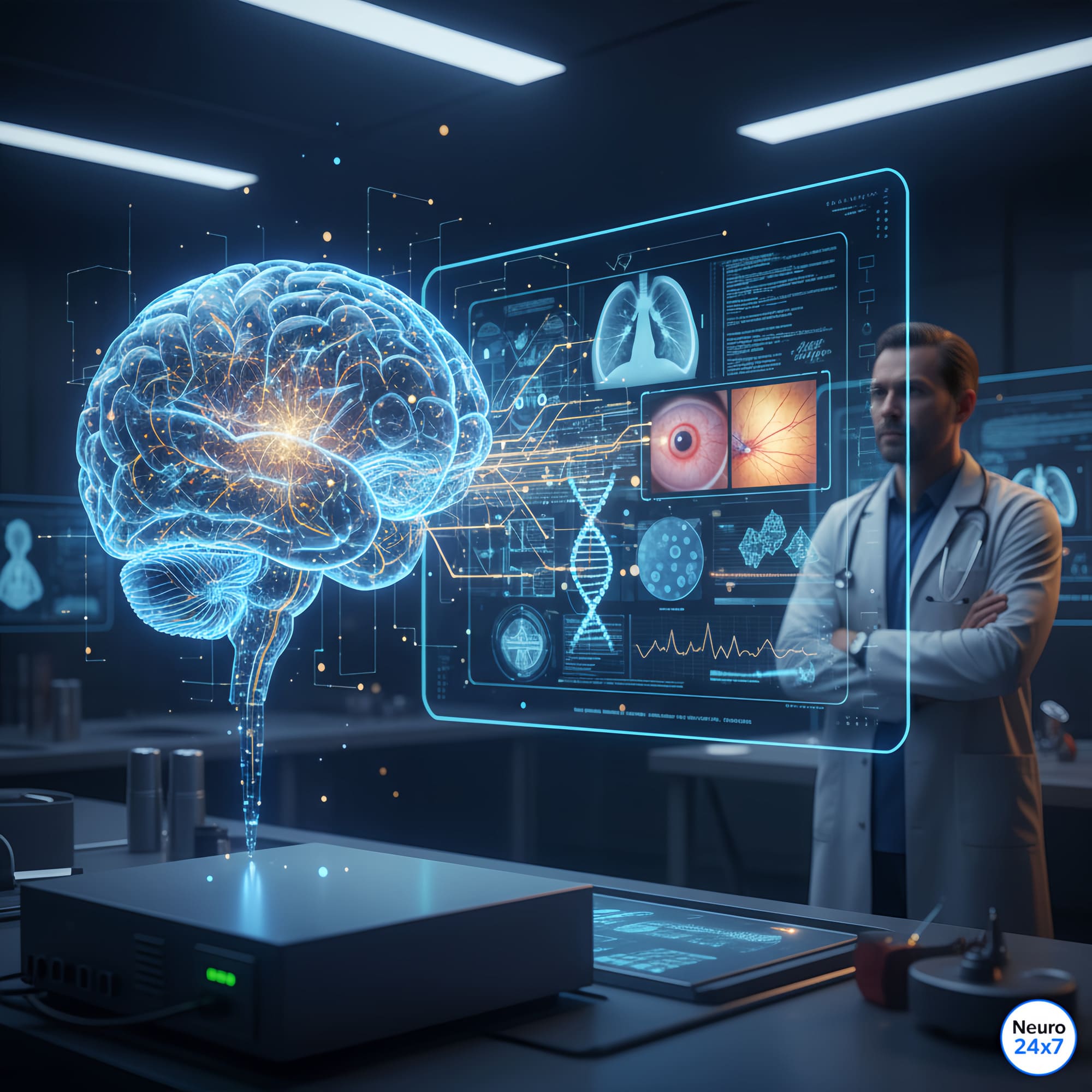
Artificial intelligence (AI) in medicine is one of the most exciting and rapidly evolving fields of modern science and technology. Today, AI opens new possibilities for diagnosing diseases, predicting their progression, and providing tools for more accurate and timely decision-making. At the same time, important ethical questions arise regarding the use of AI in healthcare, sparking interest among both experts and the general public. This article explores the key aspects of applying artificial intelligence in medicine, based on the latest research and trend analysis.
AI-Powered Diagnostics: Accuracy and Efficiency of Modern Approaches
One of the most prominent areas of AI application in medicine is disease diagnostics. Modern machine-learning and deep-learning algorithms can analyze massive amounts of medical data — from imaging to genetic information — and detect pathologies with exceptionally high accuracy. According to studies conducted by Harvard University and the Massachusetts Institute of Technology, AI systems can detect early-stage lung cancer with accuracy surpassing that of human experts. These technologies significantly reduce diagnostic time and minimize human error.
AI analyzes data from CT scans, MRI scans, and images captured by medical devices. This approach enhances the work of radiologists and pathologists by reducing the risk of missed abnormalities. Deep-learning algorithms trained on large annotated datasets can identify tumors, inflammation, and other anomalies in high detail.
AI is also widely used in diagnosing ophthalmologic diseases, such as diabetic retinopathy and glaucoma. Computer systems have already undergone clinical trials and are implemented in medical centers worldwide. Studies published in Nature Medicine confirm their high sensitivity and specificity, expanding early detection capabilities and enabling timely treatment.
Disease Prediction and the Rise of Personalized Medicine
Forecasting is one of the most promising applications of AI in medicine. By analyzing large datasets—medical history, lifestyle, and genetic information—AI systems can predict disease development and offer personalized treatment and prevention strategies.
A study conducted by the U.S. National Center for Biotechnology Information demonstrates that AI can effectively predict the risk of cardiovascular diseases, diabetes, and cancers using data from over 100,000 patients. Machine-learning models analyze biomarkers, physical activity, diet, stress, and even socioeconomic factors, giving doctors a comprehensive view of patient health.
AI-driven personalized medicine is becoming a reality. Software based on AI algorithms helps select optimal medications and dosages tailored to individual patient characteristics. This reduces side effects and increases treatment efficacy—especially in oncology, where tumor behavior varies greatly among patients.
Ethical Challenges of Using Artificial Intelligence in Medicine
Despite its advantages, the introduction of AI in medicine raises complex ethical and legal issues. One of the primary concerns is the protection and confidentiality of medical data used for training AI systems. Because healthcare relies on vast amounts of sensitive information, ensuring strong data protection standards is essential.
Another major ethical issue is the transparency and explainability of AI decisions. Doctors and patients must understand how a diagnosis or prediction was generated. Research from Harvard University and Oxford University highlights the need for interpretable and verifiable AI models that avoid mistrust and reduce the risk of errors.
Responsibility is also a critical topic:
– Who is accountable for an incorrect diagnosis made by AI?
– How should responsibility be distributed among developers, medical staff, and institutions?
These questions are actively discussed internationally in the context of regulatory frameworks and standards.
Issues of accessibility must also be addressed: ensuring equal access to AI-powered services regardless of region or socioeconomic background is essential in preventing healthcare inequality. Solving these questions requires a multidisciplinary approach involving physicians, scientists, ethicists, and public organizations.
The Current State of AI Technologies in Medicine
Current trends show that AI is becoming an integral part of medical practice. The number of startups and major companies developing AI solutions for imaging, natural-language processing of medical texts, and epidemic forecasting is growing. According to the World Health Organization, more than 90% of leading clinics worldwide already use at least one AI-based application.
Tech giants such as Google Health and IBM Watson Health are actively expanding their medical portfolios. Intelligent robots assisting surgeons during operations are becoming more common, reducing risks and decreasing procedure times.
Telemedicine is another rapidly expanding field where AI helps remotely monitor patients, detect symptom changes, and prevent critical situations — essential for rural areas and during pandemics.
The Impact of AI on the Future of Medicine
AI is expected to become a key catalyst for transformation in healthcare. As neural networks, quantum computing, and the Internet of Things (IoT) evolve, AI capabilities will continue to grow. Patients will receive more accurate, timely, and high-quality medical services.
One promising direction is the development of digital twins — virtual patient models that allow testing treatments and predicting therapy outcomes without risk. This opens new horizons for personalized care and reduces costs for clinical trials.
AI will also help address global challenges such as aging populations, chronic diseases, and drug resistance. Big-data analysis will reveal insights inaccessible to traditional methods.
Cloud technologies and mobile applications will further accelerate AI adoption, making medical services more flexible and accessible.
Ensuring the Safety and Ethics of AI in Medicine
To maximize the benefits of AI and minimize risks, experts propose comprehensive standards and protocols regulating AI use in healthcare, including:
– Strict data-protection rules compliant with GDPR, HIPAA, and other standards
– Deploying verifiable models that allow physicians to review and understand AI decisions
– Formation of multidisciplinary teams (engineers, clinicians, ethicists)
– Continuous training for medical personnel in AI technologies
– Clearly defined legal frameworks for responsibility and accountability
These measures will build public trust and unlock AI’s full potential for improving health outcomes.
Integration of AI with Other Advanced Technologies
Combining AI with robotics enables high-precision surgical assistants. IoT devices provide real-time health monitoring, feeding continuous data streams to AI systems. NLP accelerates medical document analysis, while cloud technologies ensure scalability and accessibility.
Opportunities and Limitations of AI Today and Tomorrow
AI faces several limitations:
– Dependence on data quality
– Difficulty generalizing models across diverse populations
– High computational requirements
– Lack of interpretability in complex deep-learning models
– Ethical and legal challenges
Research continues to address these issues, including the development of explainable AI and improved data standards.
AI’s Contribution to Improving Quality of Life
Faster diagnosis, accurate predictions, and personalized treatments reduce complications and improve patient well-being. AI also eases the workload on medical staff, allowing them to focus on challenging and creative tasks.
Future Prospects and New Frontiers of AI in Medicine
Future advancements include deeper neural networks, growth of bioinformatics, more advanced digital twins, and the use of quantum computing to revolutionize decision-making and medical data processing. Universal ethical and legal frameworks will be essential to balancing innovation with safety.